Friday, September 23, 2016

Belle on the Brain

“I want adventure in the great wide somewhere / I want it more than I can tell…”

My favorite Disney princess sings this line in one of the most personally moving scenes of the animated classic “Beauty and the Beast,” and this line has been running through my head all evening. Honestly, the brunette brown-eyed bookworm known as “Belle” has been on my mind a lot lately – not just today.

Maybe it’s the hype that is surrounding the impending release of the new live-action movie in March. Maybe it’s my school-loaded mind trying to escape responsibility by dwelling on happy memories and familiar storylines. More likely than not, it’s probably the fact that I’m working on a Halloween costume that is inspired by one of her dresses from the movie.

In any case, my ponderings on “Beauty and the Beast” and have led me to the conclusion that this is one of Disney’s best princess movies, and it’s not just because I share some of the heroine’s physical features – although my 4-year-old self decided that was a great reason to love the movie.
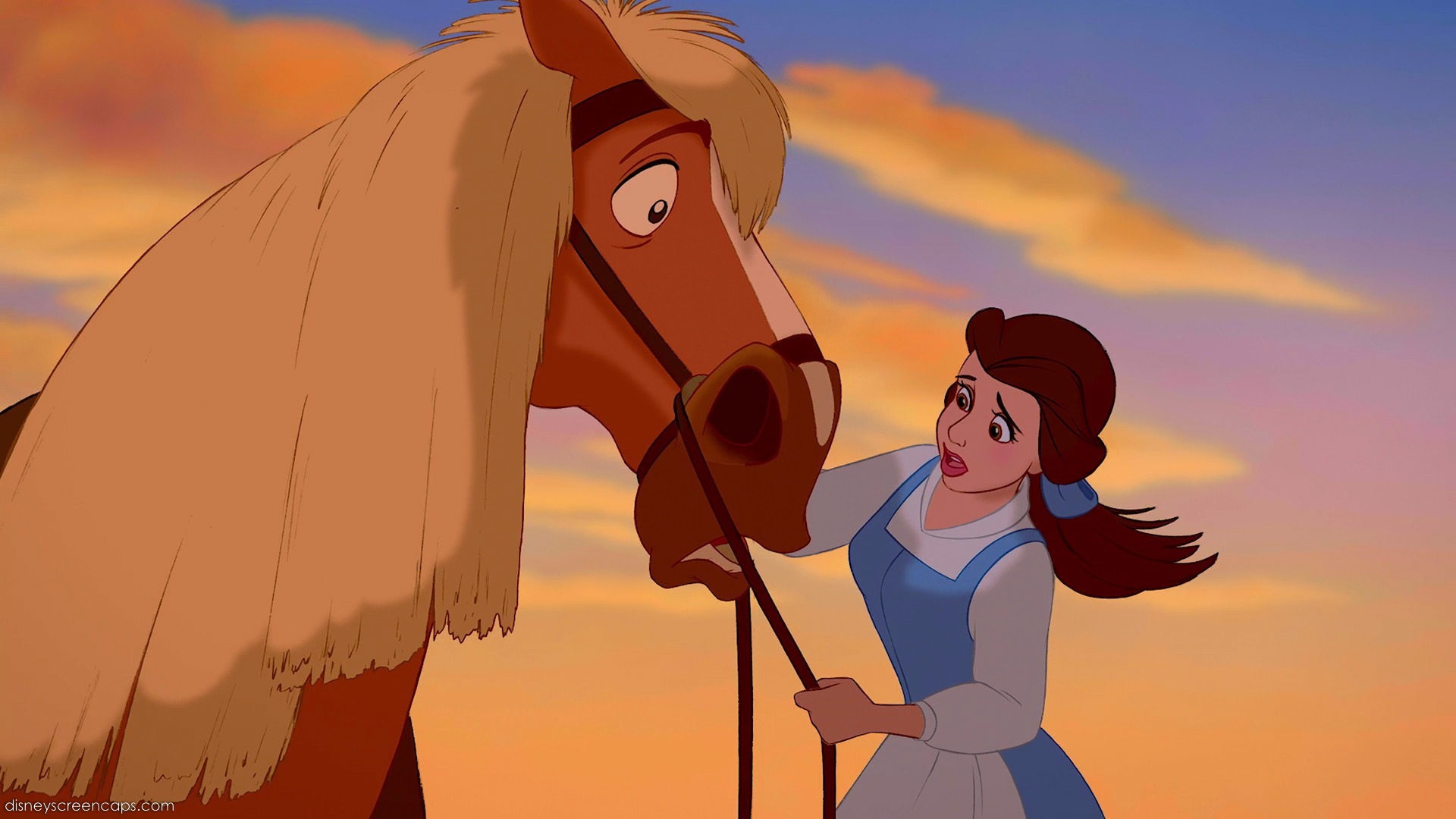

Brown hair. Brown eyes. Loves books. Has eyebrows. Met a horse once. Yup – me and Belle are definitely twinning.
No, my love for this movie goes much further than surface-level similarities. I believe Belle experiences real situations that even the most average person faces at some point in his or her life, and it is this resonance with reality that lifts this film above a veritable sea of Disney movies.

Reality vs. Imagination


During the first part of the movie, Belle yearns for the chance to live an adventure like the ones she reads about in books. She walks through town preoccupied by a story that takes her far away from “this provincial life.”

I don’t know about you guys, but I’ve definitely connected with her situation. I’ve gotten lost in another world when reading books and living vicariously through the characters. I’ve also experienced the “book hangover,” where real life is so hard to jump back into because the book provided such an intense experience. I’ve wanted adventure and ached for that which I did not have.
And then Belle gets what she wants. “Be careful what you wish for, because you just might get it.” She goes on a quest to recover her father and ends up trading her freedom for his, resulting in her imprisonment in an enchanted castle that is ruled by a terrifying beast. The animated movie does not delve deeply into Belle’s reflections on her predicament, but the musical developed for stage productions explores her emotions here in the song “Home.”

"Home" 
“What I’d give to return to the life that I knew lately / And to think I complained of that dull provincial town,” she sings. I can’t claim any connection with her situation (imprisonment, loss of freedom and family), but I can certainly relate to her experience of accomplishing a dream only to realize it bears no similarities to the imagined conception of it. Disillusionment with a once-cherished idea is a universal experience, and one that Belle embodies poignantly.

Crossing Lines


As far as heroines went, I always thought of Belle as pretty flawless. She loves her father, gives the Beast a big second chance, and throws a mean snowball.

But then I remembered the West Wing.

Belle infiltrates the West Wing, the inner sanctum which the Beast expressly forbid her to enter. She nearly touches an enchanted rose before the Beast discovers her and flies into a rage, and then Belle runs away for fear of her safety.

All ends well enough, for Beast saves her from wolves in the snowstorm outside and Belle returns with him to treat his wounds and keep her promise. They argue about where the fault lies for Beast’s injuries:

Beast: “If you hadn’t run away, this wouldn’t have happened.”
Belle: “Well, if you hadn’t frightened me I wouldn’t have run away!”
Beast: “Well, you shouldn’t have been in the West Wing!”
Belle: “Well, you should learn to control your temper.”
Silence.

Belle wins. If Beast had better control of his emotions and hadn’t been so flustered by Belle’s appearance, they could have avoided this situation altogether. What’s the big deal with the West Wing, then?

The problem here is that Beast establishes a very clear boundary and Belle ignores it. He gives her as much freedom within the castle as he can without letting her leave and asks only that she not enter the West Wing. She violates this stipulation – not out of malice or revenge (although one does wonder, considering her plight), but out of curiosity.

Look at that face. Curiosity in its purest form.

The mystery is just too enticing – she must know the secrets of the West Wing. Although Belle is scared half to death by Beast’s reaction, she brings it upon herself by prying into a very personal place. She experiences the terrifying consequences of her decision, but she also puts the Beast through agony – the one place his secrets are safely hidden has been found out, his insecurities and vulnerability exposed.

I can recall times when I have asked one question too many, when I have been Belle in the West Wing of someone’s private struggles. This sort of trespassing does damage to our own souls and character, and it is easy to reflect on how this action or that decision has been detrimental to our own person – but what has our idle curiosity cost the other person? I think I’m not the only person who has encountered this situation before.

Beast might have serious flaws, but such flaws should never have been used as a justification for crossing a boundary he desperately needed to be respected.

Eucatastrophe


In his essay “On Fairy-Stories,” J. R. R. Tolkien defines eucatastrophe as “the consolation of fairy-stories, the joy of the happy ending: or more correctly of the good catastrophe, the sudden joyous “turn”…it is a sudden and miraculous grace: never to be counted on to recur.”

Every fairy tale ends with a happy ending, but Beauty and the Beast finishes with an ending that is worthy of Tolkien’s definition of eucatastrophe. Belle and the Beast don’t just experience a happy ending; they experience a happy ending that should not have happened.

Beast dies. (For the sake of this point, please ignore the fact that pretty much every Disney character who dies comes back to life). In many the other Disney fairy tales, the main characters don’t die (Little Mermaid, Sleeping Beauty, Cinderella, Aladdin, etc.). Belle held Beast as he died. Strike one.

Not only does Beast die, but whether or not the spell under which he was cast should have been undone is debatable. The spell stated that if before the last petal of his enchanted rose fell “he could learn to love another, and earn her love in return, the spell would be broken.” But Belle says “I love you” as the last petal falls. Should that really count as “before” the last petal falls? Her timing seems questionable to me. Strike two.

The spell also said only that the spell would be broken – i.e., that Beast would get to have his human form back. He was never promised to be given his life back if he should die even in the event that the spell was broken. Belle still would have ended up alone. Strike three.

In short, Belle should never have had a happy ending, but she still gets it. In fact, she gets a happy ending at the point at which it could not – no – should not be expected. So many things went wrong, but in the end, all inexplicably came out right. Eucatastrophe.

Tolkien says eucatastrophe is a proclamation of the Gospel in that it shows death does not have the final say and that there is joy beyond the realm of this life, but I think Belle’s unbounded joy at the realization of her happy ending is a universal experience. It might happen in a big way, but I think eucatastrophes happen all the time in the little ways: a random text from a friend, being asked out to a dance, coming home to fresh-baked cookies, the forming of a friendship. We don’t necessarily expect these hardly-hoped-for goods to come our way, and we can never assume that they’ll happen again, but these are the small miracles God gives us all the time without us deserving them.

This is the face every college student makes upon hearing that class is cancelled: eucatastrophe.
http://data.whicdn.com/images/88347380/large.jpg

There are so many reasons to love Beauty and the Beast, but I hope this reflection displays the real merit of this universally relatable film.

Sunday, September 4, 2016

"Too Personal"

“‘He is my enemy,’ said Evan, simply; ‘he is the enemy of God.’


Mr. Vane shifted sharply in his seat, dropping the eye-glass out of his eye in a momentary and not unmanly embarrassment.


‘You mustn’t talk like that here,’ he said, roughly, and in a kind of hurry, ‘that has nothing to do with us.’


Evan opened his great, blue eyes; ‘God,’ he began.


‘Be quiet,’ said the magistrate, angrily, ‘it is most undesirable that things of that sort should be spoken about – a – in public, and in an ordinary Court of Justice. Religion is – a – too personal a matter to be mentioned in such a place….to talk in a public place about one’s most sacred and private sentiments – well, I call it bad taste…I call it irreverent.’”


What do you think you just read? A scene from a recent crime novel? A snippet of dialogue from a magazine serial I just read?

Guess again. The words I’ve quoted here originate in a book published over a century ago, “The Ball and the Cross” by G. K. Chesterton.

I hope you can see how relevant this passage is to our modern culture. When I picked up this book, I could not predict that I’d be floored by how applicable these words are to my own time. I felt as if rather than commenting on the society of his time, Chesterton had been granted a glimpse into the future and wrote for generations a hundred years away.

Maybe that is exactly what happened – I don’t know.
           
In any case, this passage resonated with me and I knew I needed to discuss what I found in these words.

I’ve grown up in a society where talking about God and faith has been discouraged. I’ve seen the above situation played out – not verbatim, but certainly in spirit – in situations from discussions about separation of Church and state to the awkwardness of bringing up my Catholic faith in non-religious settings.
           
“That has nothing to do with us,” society seems to say. Even within families this seems to be an issue. What’s the rule for Thanksgiving dinner? “Talk about anything except religion and politics.”
           
For a long time, I’ve subscribed to the view that religion underpins an individual’s worldview. It doesn’t matter if a person worships at the altar of God or at the altar of something lesser – fame, money, an ideal, science, oneself – everyone has a religion.

Religion provides the framework for life: if a person takes his or her faith seriously, that faith will help determine how this person lives. My Catholic faith affects how I work, who I go to for help, and (hopefully) how I interact with others at the most basic level. As even the magistrate recognizes, these are very personal matters and “one’s most sacred and private sentiments.”

Some might argue that religion is TMI, or too much information. It’s a topic that’s too personal, too taboo to mention in public. It makes people uncomfortable.

That’s my impression of how my modern culture feels. But, I would like to argue that when we lock out religion and discussions of faith, when we ban the topic from the public sphere, as a society we are saying that we don’t care about the one of the most fundamental elements of a person’s existence, and because of that, we don’t really care about the person.

It’s like saying that we want a person to create a public mural but their paints and tools and experience from art classes have to remain at home. Have you ever tried baking a cake without referring to the instructions or any of the lessons your mom taught you about kitchen safety? You just can't - at least, you can't do that and expect to have unburned fingers and a finished product anything like what you wanted it to be.
“Bring your skills and lesser qualities to work, but leave your immortal soul and your entire understanding of life at home.” That’s pretty utilitarian, but that’s how life seems sometimes. Forbid the thought that we should ever interact with integrated individuals who are the same person at home as they are at work or in the grocery store or at the park.

So what are we to do? We have two options: we can stay quiet about our faith and go with the flow like our culture tells us. Or, we could push ourselves to open up about our faith and how important it is in our lives. Religion is such a fundamental aspect of each individual that it shouldn’t be – it can’t be – swept under covers and kept out of sight.

So speak out. Tell the world what Jesus has done for you. Tell your coworkers and classmates and friends the real reasons why you act the way you do.

I know I’m going to keep quiet and mess up at times, but I am going to try to bring my Catholic faith to the world. It may not want such a personal element of me, but that is what I have to share with it.

Sunday, August 21, 2016

Getting Deep About a White Christmas Dance Number

Today I am going to tell you all about my favorite movie dance number ever, gush over the many reasons why I enjoy it so much, and then get all deep about what I think it says about gender roles. In case you are wondering: Yes, I do tend to extrapolate large points out of frivolous movies. I also understand that Rom-Coms are actually horrible places to find any sort of truth about male-female relationships. However, I am just using this dance as an example to illustrate a larger point because I think it does so well.

Another disclaimer: I am no expert in dance so I cannot speak to the technical merits of this number. I can only talk about what I get out of it. As I address this, I’ll talk about the actors themselves, not about their characters as I think some of the things I address are best addressed to them, not their characters.

I’m really looking forward to this.

So, without further ado, I present,  “The Best Things Happen While You’re Dancing” from White Christmas featuring Vera Ellen as Judy Hanes and Danny Kaye as Phil Davis.


Now that you have watched the clip.  Go and watch it again and again.  Really let it seep into your soul.

Long have I loved this dance number.  Perhaps what I love most is that the point of the song is played out in the choreography. You can express yourself and get to know someone through dance in a way that you cannot in any other way. It is a beautiful point that is only driven home all the more by the effect that this dance number has on Judy and Phil’s relationship throughout the rest of the movie. But what would this scene be without the beautiful dancing?

I have always fawned over Vera Ellen’s lightness and precision of movement in the number.  I have dreamed of such grace while wearing such a dress.  I have pined for the opportunity to shine so thoroughly, to express myself by doing the things I “would not do at home [but that would] come naturally on the floor.”  One day I will dance like that!

Recently, however, I noticed something different. I realized that I had only been watching half of this dance.  I realized that I had been totally ignoring Danny Kaye.

Admit it.  When you were watching this, you weren’t paying any attention to the guy were you?

After I had this realization, I immediately turned around and watched Kaye exclusively through the whole dance. If I did not love this dance number before, I am totally enraptured by it now.  Danny Kaye is so graceful, so suave. He looks entirely contented, as if all is right in his world. And his dancing is so smooth.

I think one of the great beauties of this number is that the dancers always show great restraint in their movement and, in that, they are really able to shine.  At parts it is as if they are savoring the moment.  At others, it is a frenzy of activity.  This is especially interesting with Kaye.  If you watch him throughout the movie, he is a high energy guy. Seeing this kind of restraint from him is marvelous and impressive. And how about their easy chemistry, though? It’s so perfect that no one in the movie ever doubts that they’re going to get married.  Except Bing Crosby’s character Bob.  He calls Phil a “Weirdsmobile” at the idea…because Bob’s a a bitter, lonesome old man.

The progression of the dance is also worth note. It starts off slow with Kaye singing and Ellen coyly following along to his lead.  As they move down to center stage, you can see the dance becoming more flowery.  Ellen has bigger, more complex movements.  At one point (my favorite point), Ellen drops into a beautiful deep dip in synchronization to the word “naturally,” as if to punctuate the point of the song.  As the song goes on, Ellen more frequently runs off to start her own bit, which Kaye will follow and synchronize with.

In the last part of the number, the part where they return to center stage after dancing on the bridge and boat, I really enjoy watching their faces.  You can tell that they are both high on the dancing.  Ellen is in a flurry of activity and Kaye is totally working it, enjoying every second.  By the way, did you see that she trips over his foot right at the very end?

While they are dancing, did you notice that Ellen is always acting towards the audience. Kaye, however, is always paying attention to her and he seems to be overjoyed to be a part of the experience.  I think this goes to show again that the woman is basically always the star of any couple’s dance and the guy’s role is to support that. If you watch, you can see he is always paying close attention so as to catch his next move or to anticipate her needs.

Okay, so here I’m going to pull a comparison about men and women’s relationships.  If you become uncomfortable or angry and preachy when people agree with traditional gender roles and use Bible verses to do it, then you might want to retreat to a corner of the internet that always agrees with you.

I’m Catholic.  Often, at Catholic weddings, the Bible verse about “Women, be subordinate to your husbands.  Husbands, love your wives as Christ loved the Church and laid Himself down for her” comes up.  When I watch Danny Kaye dancing with Vera Ellen here, I cannot help but be reminded of this Bible verse.  According to this Bible verse, men have to be willing to support women and appreciate their God given beauty, even if it means dying to themselves.  Kaye doesn’t really get a lot of attention in this dance.  He’s doing a stellar job, but he's not really the star.  Ellen is.  His role in the dance is supporting her elaborate and elegant moves.

Ellen, on the other hand, is not enslaved by Kaye’s lead.  On the contrary, she works within his parameters and shines all the more brightly because of it.  If she had decided to preempt his lead to dip her, she might have wound up on the floor in an undignified heap.  If she was too good to be helped by him, she would have had a slow and ungraceful time of getting off that boat.  However, because she is willing to work with him, we get a ridiculously graceful and fluid product.

Think I’m full of it? What do they say right after they finish? Ellen: “I guess I got carried away.” Kaye: “And she carried me right along with her.”


Yeah, guys, leave it to me to draw a deep point about human relationships out of an Irving Berlin dance number.

Saturday, August 20, 2016

Gandalf and Speech Pathology

“Look out for me, especially at unlikely times!” –Gandalf, "The Fellowship of the Ring"


I learned much about the field of speech-language pathology this week: presentations, CPR, paperwork, professional communication, and specialized computer programs are just a few topics that came up this week.

In the midst of this overwhelming sea of new information, I found my knees shaking a little.

Don’t misunderstand: I am excited to dive into this field and I believe this will be an amazing experience.

However, I also know that there is a lot for me to learn. I approach the coming months with confidence, but not entirely without misgivings about how smoothly the weeks will go.

But in the midst of this newness and change, I found encouragement for my speech pathology pursuits in an unexpected place: Gandalf, my favorite character from my favorite book series, The Lord of the Rings. (Props to Gandalf, by the way, for appearing at an unlikely time in this case, just like he did for Frodo and Bilbo.)

What does Gandalf have to do with Speech Pathology?


As I learned from a presentation given a few days ago, when a speech therapist works with a client, the intent is to help the client communicate or swallow more effectively.

Other than Gandalf’s obvious affinity for talking, there’s not much this evil-fighting, horse-riding, adventuring wizard has in common with a speech pathology student. What’s the connection?

The connection lies not so much in what we do, but in how we go about doing our business.

I’ll start by laying out what speech pathologists are supposed do when they have a client referred to them.

Before a speech pathologist sees the client, he or she does research prior to an evaluation. Speech pathologists find out why the client is coming to them and look at family history and medical history (as long as it is made available – medical privacy is important). If questions remain, the speech pathologist may seek more information from the family or the referring doctor. When they finally meet for the evaluation, the speech pathologist administers tests and/or examines the client and finds out what he or she (the client) can and cannot do. The speech pathologist, based on expertise and testing, then writes down their recommendation – the client should receive services, should not receive services, etc.

Guess what? Gandalf researched too. When Bilbo left his ring to Frodo, Gandalf decided he needed to find out what exactly this ring was. Taking on the roles of both concerned parent and knowledgeable professional, Gandalf notices something that might be a problem and looks into it. He has some pieces of the puzzle – Bilbo found this ring, had it for x many years, ring appears to have y magical qualities. This is clearly a ring of power, Gandalf decides. But which one?

Thanks to his research, the wizard learns the history of a certain One Ring (which the bad guy is desperate to reacquire): after passing hands multiple times, it went missing. Also, he discovers that placing the One Ring in a fire reveals an inscription that proves it to be the One Ring that controls all the other rings of power. Finding this ring was kind of a big deal.

Gandalf returns to the Shire, has Frodo perform the fire test, and bam – Gandalf has some recommendations to make.

Research, tests, diagnoses – turns out Gandalf and speech pathologists engage in pretty similar activities. Let’s not forget that, like Gandalf, speech pathologists make a journey with the people they work with. Gandalf travels to the Lonely Mountain and across Middle Earth with specific groups, and speech pathologists “travel” through therapy with their clients.

And finally, when the time comes for clients to move on without services anymore, the professionals take their leave: professional speech pathologists dismiss their clients, and professional world-savers let go of the reins and travel across the sea.

Speech pathologists may not perform on as novel-worthy a level as Gandalf, but it is encouraging to me to know that exciting events can be rooted in what originally appears as mundane and ordinary tasks.

Give Me the Lobster!

It's an integral part of human nature: we always want what we can't have.

I recently viewed an episode of "How I Met Your Mother," in which a main character, Robin, wants to pursue a relationship rather abruptly because she's been told the other party has given up trying to win her over. Her friend, Lily, draws a parallel between this situation and the "Lobster Incident": Robin was told she was allergic to lobster and could never, ever have it again. Though it almost killed her, she immediately went out and ate a giant plate of lobster. Lily's point was that Robin only thinks she wants this relationship because she wants what she can't have, now that the door has been shut on a possible future.

What is our obsession with the forbidden? Why do we have a compulsion to do what is bad for us, especially when we know it's bad for us? Two reasons: 1. We remember the experience of past pleasure as better than it actually was, and 2. We are constantly seeking happiness; that frequently translates into gratifying, instantaneous pleasure.

Regarding the first point
Our memories are flawed; we tend to romanticize the past. For example, when Robin was told she could no longer eat lobster, she probably wanted it because in her memory, the brief experience of satisfaction and pleasure was so great that she gave it precedence over her health. When we recall minor pleasures, even if they had negative effects, we tend to maximize the memory of the pleasure and minimize, if not eliminate, memories of the negative consequences.

Regarding the second point
We instantly want things we have been told to avoid--but have not experienced for ourselves--because we imagine a pleasurable outcome. We become curious to try things people have told us to avoid. We imagine the experience will somehow be different for us, or that the other person is (for some reason) trying to prevent us from having a new experience of pleasure. We are constantly seeking happiness, and foolishly believe this happiness will come from experiencing pleasure. We operate under the error that pleasure and happiness are equivalent.

In fact, the reality of happiness--joy--is quite different, and the journey toward it often is quite lacking in pleasure. We have to suffer for it. It seems contrary to rational thought, but we didn't make the rules--we simply follow the example of the person who did it first: Christ. As St. Elizabeth Ann Seton said, "Can you expect to go to heaven for nothing? Did not our Savior track the whole way to it with his tears and blood? And yet you stop at every little pain."

It is a truth universally acknowledged that joy, pleasure, or accomplishment achieved without effort is worthless and unsatisfying. We cannot go anywhere without moving; we cannot ever have the experience of true joy without first knowing true sorrow and pain. We would have nothing with which to compare the experience, and the moment would be worthless. It is the biggest conundrum of life that we have to deny ourselves the instantaneous pleasures within our reach that are bad for us in order to grasp at the beginnings of real, hard-won joy.

No matter how much you think you want that lobster, it will never be enough.

Wednesday, July 13, 2016

Books with a Letter Missing


In 2013, some clever Twitter user came up with the hashtag #bookswithalettermissing. This particular phenomenon resulted in some real gems, such as Here’s Waldo? (from Where’s Waldo?) and The Lion, the Itch, and the Wardrobe (from C. S. Lewis’ famous children’s book).

Just for funsies, I decided to do the same with the titles of books that I’ve read, each of which is accompanied by a synopsis of new the story bearing the altered title. The synopses pull material from the original stories, so they will make more sense if you are familiar with the books. So here’s to the [not-so-] fine literature that might have been.

1.      Jane Eye (from Jane Eyre by Charlotte Bronte)

This romantic drama centers on a dark, brooding man and his love interest, a “plain” clothes private eye named Jane. Jane’s amazing eye for unusual details takes her from the boarding schools of young girls to the open spaces of England in this tale of mystery and suspense.

2.      The Cure of Capistrano (from The Curse of Capistrano, the original name of The Mark of Zorro by Johnston McCulley)

A mysterious masked man has been wandering El Camino Real at night, attending to the sick, neglected, and injured of southern California. A corrupt band of governor-backed doctors feels threatened by this no-good do-gooder and seeks to put an end to the masked doctor’s work.

3.      Out of the Silent Plant (from Out of the Silent Planet by C. S. Lewis)

An Oxford don is tricked by his colleagues into taking charge of a strange new species of plant. Upon examination, he finds that the “silent plant” is full of alien creatures that, though exhibiting an understanding of his language, refuse to communicate with him. The colleagues, after learning about the discovery, greedily seek to recover the plant and force the creatures to reveal their wisdom.

4.      The Silver Hair (from The Silver Chair by C. S. Lewis)

Eustace and Jill travel to Narnia to save Prince Rillian from his obsession with his youth and good looks (the prince’s worrying has resulted in the growth of a silver hair on his head, rendering him hysterical). The prince is plucked from danger and order restored.

5.      Little Hose on the Prairie (from Little House on the Prairie by Laura Ingalls Wilder)

Laura Ingalls and her family move west and her biggest chore is to water the garden and the homestead trees. How can Laura accomplish this huge task daily when her only tool is a tiny hose?

6.      Mansfield Ark (from Mansfield Park by Jane Austen)

The sweet and humble Fanny Price refuses to participate in a poorly-rendered theatrical production of Noah’s Ark, the consequences of which are disastrous for the Crawfords and result in her marrying the man of her dreams. In an ironic twist of fate, however, the ark completed for the ill-fated drama saves the heroine and her family on her very rainy wedding day.

7.      Lint (from Flint by Louis L’Amour)

This is a Western tale about how a businessman from the coast defeats gunmen and cattle-rustlers using nothing but the lint from his pockets.

8.      Men of Ion (from Men of Iron by Howard Pyle)

Young Myles joins forces with some other squires to stop the bullying of the older bachelors. However, what originally began as a promotion of justice suddenly turns into extremely advanced scientific discoveries.

9.      The Princess Ride (from The Princess Bride by William Goldman)

A father begrudgingly rides on a princess-themed amusement park ride, but quickly finds that it is far more exciting than he believed possible. Filled with fencing, fighting, torture, revenge, monsters, chases, escapes, true love, and miracles, this ride is more than he bargained for – and probably not entirely age-appropriate for his four-year-old daughter.

10.  Rewall (from Redwall by Brian Jacques)

The peace-loving creatures of the Abbey decide they must re-wall their outer defenses. But, due to some terrible timing, Cluny the Scourge arrives on the scene and the construction plans put the Abbey in mortal peril. A young mouse with mixed-up priorities leaves the defense of his home to other creatures and roams the countryside in search of a mystical sword.

Wednesday, June 29, 2016

The Tragedy of Peter Pan

Peter Pan is a delightful adventure that conjures pirates, fairy dust, mermaids, and being up long past bedtime. Peter Pan himself is the magical boy of eternal youth that can steal you away from your window and carry you to Neverland. But, as the book points out, there is no such thing as eternal youth--everybody must grow up. Except one.

Peter Pan is famous for insisting that he will NEVER grow up. Consequently, he will also never mature. He will retain his youth along with his juvenile worldview and emotions. While it is wondrous to see the world through the eyes of a child, a child's comprehension is very limited, and their entire focus is on their own well-being. Peter Pan is extremely limited in this respect, and his millennia as a never-aging child give him a rather sinister quality.

For example, after he first meets Wendy and turns to go, she entreats him to stay by saying she could tell him lots of stories. The narrator tells us that Peter "came back, and there was a greedy look in his eyes now which ought to have alarmed her but did not" (Barrie 26). He wants Wendy (or rather, her stories) for himself, and he intends to take her. While persuading her to come, Peter "had become frightfully cunning. 'Wendy,' he said, 'how we should all respect you'" (27).

He does convince the Darlings to accompany him to Neverland. It's a long way, and they get tired. Sometimes, they fall asleep and drop out of the sky, and Peter catches them, but "he always waited till the last moment, and you felt it was his cleverness that interested him and not the saving of human life" (32). 

While the Narrator is describing Neverland, he notes that "the boys on the island vary, of course, in numbers, according as they got killed and so on; and when they seemed to be growing up, which is against the rules, Peter thins them out" (39). That is one of the most disturbing things the Narrator has told us yet--Peter kills off the Lost Boys if they get too old. Another rather violent suggestion the Narrator makes is in the discussion of each boy's unique, perfectly-fitted entrance to their tree-house: "if you are bumpy in awkward places or the only available tree is an odd shape, Peter does some things to you, and after that you fit" (56).

Peter's undiminished hatred toward adults is also evident throughout the story, from his ban on all talk of mothers to the moment when he deliberately takes as many quick, short breaths as he can because he heard a saying that doing so kills grownups (65). It is indicated that Peter was abandoned as a baby and afterward came to Neverland; his resentment and abhorrence for adults is obviously a result of this incident. It is ultimately this that makes him tragic: he can never grow up, and so he hates those who can and will never understand the things they understand or have the love they have.

All of these examples show that eternal youth, especially when that means perpetual childhood, is actually a horrible fate. Peter is only capable of a child's selfish love and seems to have lost his appreciation for the sanctity of human life. He has become extremely manipulative and cunning. He plays with others' lives casually and eliminates them when he is bored. Additionally, because of his immature state, he is incapable of the relational love between a man and a woman: "'You are so [strange],' he said, frankly puzzled, 'And Tiger Lily is just the same. There is something she wants to be to me, but she says it is not my mother'" (81). 

Perhaps the most tragic moment of all occurs when Peter is looking back through the window at the happily reunited Darling family and the newly adopted Lost Boys, and knowing that "he was looking through the window at the one joy from which he must be forever barred" (126). All Peter can do is forget and find new children, all over again.

Peter's whole personality is summed up perfectly by the Narrator's description of every child: "Off we skip like the most heartless things in the world, which is what children are, but so attractive, and we have an entirely selfish time, and then when we have need of special attention we nobly return for it, confident that we shall be embraced instead of smacked" (85). Peter can never grow up to be the one doing the embracing. And that is tragic.